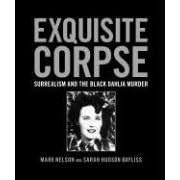
Even if I didn't buy the premise - surrealism, and the Black Dahlia! I had to have it.
Heretofore I've been blasé about the George Hodel hypothesis - a surgeon with friends in the movies and with surrealist connections (notably his friend Man Ray) whose son has become convinced that his father murdered and bisected Elizabeth Short, aka the Black Dahlia. I have always leaned toward John Gilmore's assertion - that an itinerant, creepy loner named Jack Anderson Wilson killed the aspiring actress, as well as an heiress named Georgette Bauerdorf. Always leaned toward that assertion, that is, until now.
Certainly I do not think that surrealist art, which I admit is full of distorted and bisected "muses," is the cause of Elizabeth's death - surrealism is about the unconscious, what intrigues and frightens us, and certainly would have many parallels with a notorious crime that also intrigues and frightens us. However, the facts about Hodel are fascinating - and unsettling. Enough so to allow me to change my mind.
I have not read the book Black Dahlia Avenger by his son Steve Hodel, and I must say that the two photographs allegedly of Liz Short that Hodel found in his father's possession, do not resemble her at all. But there are many other details - too many to recount here - that have piqued my curiosity - and my alarm. I think there's something to this.
Certainly Hodel's book is more plausible that the trash written by Janice Knowlton, who only has "repressed memories" [remember that fad?] on her side, and who behaved rather disgracefully toward the person who has maintained what I consider to be the authoritative online resource on this crime.
So at this point I am in a holding pattern as to the merits of this new hypothesis. I must add that none of these books have supplied enough information for the LAPD to officially reopen the case.
Another resource I've found is this haunting film, a visual timeline of the crime and its aftermath, put together by a filmmaker named Larry Harnish. Masterful work, Larry! Larry also has his own hypothesis as to the murderer's identity. I think his is quite plausible, too.
Of course the last thing I could want would be a deep connection between surrealism and this murder, but in the final analysis this crime is surreal: from Elizabeth's father having faked his own death, to her tragic loss of Matt Gordon, to the incarceration of cleared murder suspect Red Manley in an insane asylum, to the false confessions and the mystery of her whereabouts in those final days.
Some feminists have accused surrealism of being anti-woman, of bisecting and fragmenting the female form out of hatred, but I am with with Dorothea Tanning (wife of Max Ernst) when she asserts:
Intellectually, they [the surrealists] flew close to the flame. Instinctively they were far from knowing the perverse appetites they so admire and glorified. As for emulating the fantasies of Sade's personae, they didn't even try...
As for these fragmented images of women, she add:
They were disguised hymns to her mystery. I don't believe that even in the most romantic moments of literary history have writing men so adored the idea of woman.
Nor do I. It follows therefore that the death of Elizabeth Short is surreal because life is surreal. Whether surrealism contributed to her death or not, via the misguided "artistic" expression of a violent wannabee, remains to be seen. But it does not surprise me that she could have become a sort of surrealist heroine to the artists in George Hodel's circle, including Man Ray and Marcel Duchamp, and if this is the case, then it illustrates Tanning's comments above.
It is a sad fact that bourgeois society, while pretending to be so righteous, tends to glorify the
criminal (Charles Manson, the Zodiac Killer, PTK, etc.) rather than the
victim of a famous crime, whose name is all too often unknown to the public - but Elizabeth Short is an exception.
This crime is named after
her - not her murderer. It is
she who walks in the minds of those like me who are fascinated with her story. It is her charm and her beauty that stares out of photographs and into the hearts of people like me who want to solve this crime. Whoever her murderer is, he could never be as interesting as she was.